In April 2017, 22-year-old Jacob Gray vanished while preparing for what was supposed to be a cross-country bicycle journey. His disappearance in Washington's Olympic National Park attracted widespread attention after park rangers found his bicycle and equipment abandoned but found no sign of Gray himself.
The mystery deepened when his remains were eventually discovered more than a year later in an isolated wilderness area far from where his bicycle had been left behind. While the case was officially resolved following the discovery of his remains, many questions surrounding his final movements remain unanswered.
Background
Jacob Gray was originally from Santa Cruz, California. In early April 2017, he was in Washington state preparing for a lengthy bicycle trip across the country. According to family members, Gray intended to travel east toward Vermont, where his brother was stationed with the U.S. Coast Guard.
He departed Port Townsend, Washington, on April 5, 2017, towing a trailer carrying camping equipment and supplies. Family members understood the trip to be both an adventure and a long-term journey that could potentially last months or even years.
The Disappearance
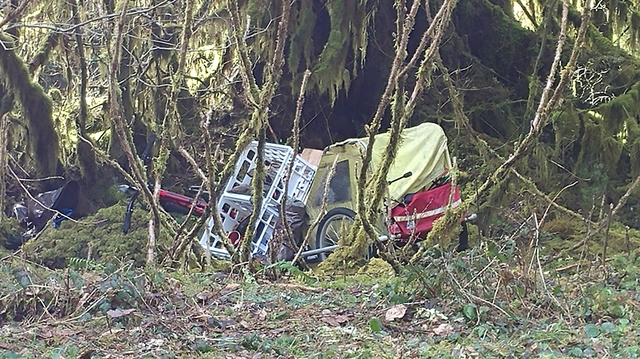
On April 6, 2017, a park ranger discovered an unattended bicycle and trailer approximately 6.5 miles up Sol Duc Hot Springs Road inside Olympic National Park. The equipment appeared functional and undamaged.
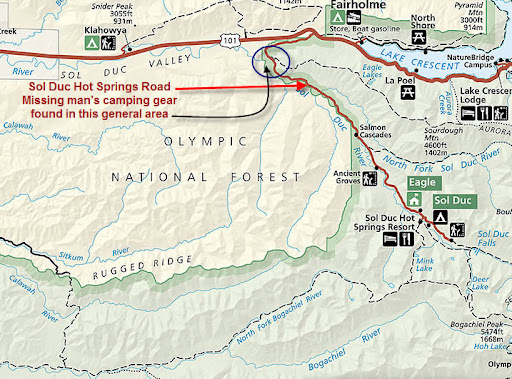
Among the items left behind were Gray's wallet, identification, and much of his camping gear. Rangers found no signs of a traffic collision, criminal activity, or struggle. Some items, including a water filtration system and hydration pack, were reportedly missing, suggesting Gray may have left the bicycle intentionally and continued on foot.
Initially, investigators considered the possibility that Gray had gone to a nearby river to collect water and accidentally fallen into the fast-moving, near-freezing current. However, no evidence was immediately found to support that theory.
TIMELINE
| Date | Event |
|---|---|
| April 5, 2017 | Jacob Gray leaves Port Townsend, Washington, towing a bicycle trailer loaded with camping gear. |
| April 6, 2017 | Rangers discover Gray's bicycle and trailer abandoned along Sol Duc Hot Springs Road. |
| April 7–8, 2017 | Rangers identify the owner through contact information found among his belongings and notify family members. |
| April 2017 | Family members travel to Washington and conduct extensive search efforts alongside volunteers. |
| 2017–2018 | Continued searches fail to locate Gray. |
| August 10, 2018 | Skeletal remains believed to be Gray are discovered in the Daniel J. Evans Wilderness. |
| October 2018 | The case is publicly listed as resolved after identification of the remains. |
Search Efforts
After learning of Jacob's disappearance, his family traveled from California to Washington and became heavily involved in search efforts.
Family members searched riverbanks, dense forest, and remote terrain throughout the area surrounding Sol Duc Hot Springs Road. They also advocated for expanded search operations, including the use of dog teams and additional resources.
According to reporting published by Bicycling, Gray's family expressed concerns that the initial search response was limited due to staffing shortages and competing incidents occurring within Olympic National Park at the time. Search efforts eventually expanded, but no definitive trace of Gray was discovered during the critical early weeks of the investigation.
Investigation
The discovery of Gray's bicycle created a difficult investigative puzzle. His equipment appeared to have been deliberately left behind rather than abandoned after an accident.
Investigators examined several possibilities, including:
- An accidental fall into the nearby Sol Duc River.
- A wilderness accident after leaving the roadway on foot.
- The possibility that Gray intentionally entered the backcountry.
No evidence publicly released by investigators indicated foul play.
The mystery intensified after Gray's remains were found in August 2018 near Hoh Lake in the Daniel J. Evans Wilderness, an area roughly 15 miles from where his bicycle had been discovered and at an elevation exceeding 5,000 feet. The route between the two locations traverses challenging mountain wilderness terrain.
Theories and Questions
The following theories are discussion points and not established facts.
Accidental Wilderness Death
The most widely accepted explanation is that Gray entered the wilderness on foot and later died as the result of an accident, exposure, or another environmental hazard.
This theory aligns with the eventual discovery of his remains deep within the backcountry and the absence of evidence suggesting criminal activity.
Why Leave the Bicycle?
One of the central unanswered questions is why Gray abandoned a fully functional bicycle, trailer, identification, and much of his equipment.
Investigators never publicly established a definitive reason for this decision. The fact that some water-related gear appeared to be missing has led some observers to believe he intended only a temporary excursion before returning to the roadway.
How Did He Reach the Wilderness Area?
Another lingering question involves Gray's route from Sol Duc Hot Springs Road to the area near Hoh Lake where his remains were ultimately discovered.
The terrain between the two locations is rugged and remote. Publicly available information has not fully explained the sequence of events that led him there.
Current Status
Jacob Gray's disappearance is officially considered resolved following the discovery and identification of his remains in 2018.
However, the precise circumstances surrounding his death remain unclear. No publicly released evidence has conclusively reconstructed his movements after he left his bicycle along Sol Duc Hot Springs Road in April 2017.